
Emergency information sheet for seniors
An emergency information sheet for seniors should put your parent's identity, health card number, allergies, emergency contacts, health care providers, document locations and daily care notes in one place. CareMapAI's Emergency Access Sheet lets you record those details, see what is missing, then print or download the sheet.

The problem
Your phone rings while you are away from home. Someone needs your parent's health card number, the name of the person with power of attorney and the place where the insurance papers are kept. You know the answers, usually. They are in a folder, a text thread and the part of your head that never gets a break.
The problem is not a lack of care. It is that one person has become the map. When somebody else has to step in, you fear that one missing detail will slow them down at the worst time. You should not have to rebuild the whole picture from memory while you are already dealing with an emergency.
You are not the first
Most family caregivers end up as the person who knows where everything is. A sister may know the pharmacy, a neighbour may know the front door code and you may be the only person who can connect the name of a document with the drawer it is in. That is a fragile arrangement. It puts too much weight on one phone call.
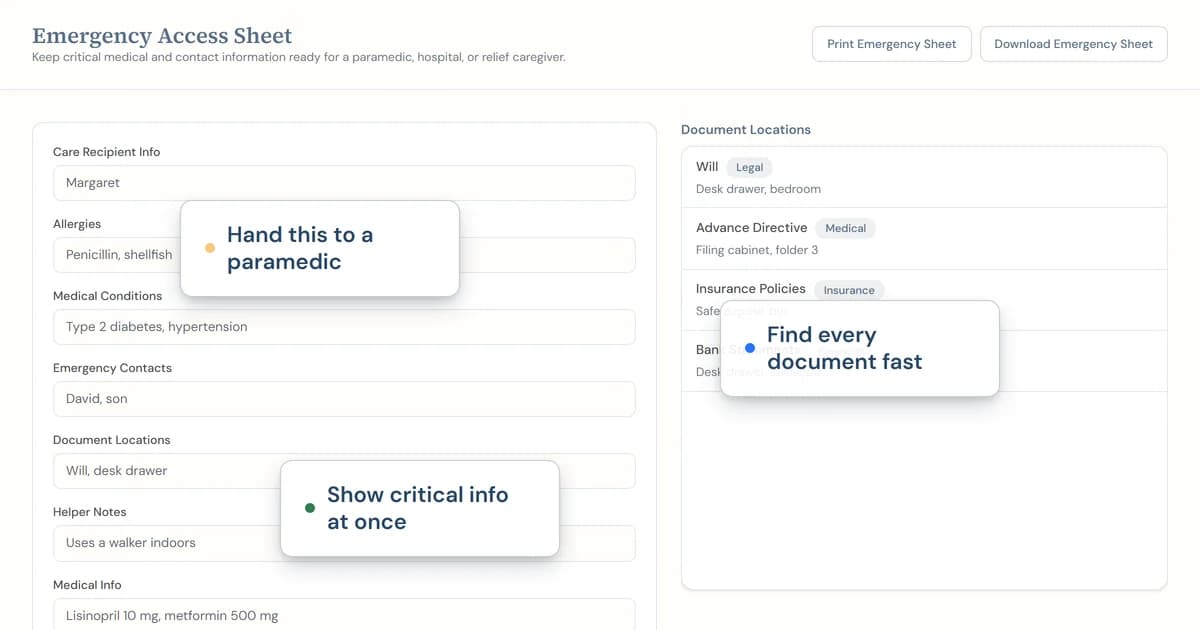
The Emergency Access Sheet gives those details a shared home. It has sections for personal information, emergency contacts, document locations, medical information and helper notes. The sheet is built around the information a relief caregiver, hospital or paramedic may need to find quickly. You still decide what belongs there. The tool gives it a clear place to live.
How does the Emergency Access Sheet work?
CareMapAI's Emergency Access Sheet gives you one editable sheet for the information that is usually scattered across home files and messages. You type your parent's name, address, date of birth, health card number and blood type, along with allergies, medical conditions and health care providers. You can also add primary and secondary contacts, plus healthcare and financial power of attorney contacts.
The same sheet holds locations and access instructions for legal, medical, insurance and financial documents. It has notes for daily routine, care preferences, mobility or equipment and communication. Its completeness bar shows the percentage filled in, so an unfinished section does not stay invisible. The downloaded text file contains only what you type into the sheet. The printed sheet also pulls saved medications from the Medication & Appointment Organizer and focus areas from the latest assessment.
What you get
- One emergency sheet with your parent's personal details, health card number and blood type
- Contact entries for primary, secondary, healthcare power of attorney and financial power of attorney contacts
- Document-location entries for legal, medical, insurance and financial records
- Medical information sections for allergies, medications, conditions and health care providers
- Helper notes for daily routine, care preferences, mobility or equipment and communication
- A completeness percentage that shows how much of the sheet is filled in
- A printed sheet that also pulls saved medications and focus areas from the latest assessment
- A text file from "Download Emergency Sheet" containing only what you type into the sheet
How it works
- Add your parent's details, contacts and document locations to the sheet.
- Write the medical information and helper notes another caregiver would need.
- Check the completeness bar, then print the combined sheet or download your typed details as a text file.
What should an emergency information sheet contain?
An emergency information sheet for seniors should contain enough detail for another person to identify your parent, contact the right people and find the records that matter. Start with their full name, home address, date of birth and provincial health card number. Add allergies, health conditions, health care providers and the people to call. Write the document location precisely, including the room, drawer, folder name and any access instruction an authorized person will need.
The Government of Canada's emergency kit checklist includes a medication list, medical insurance information, a provincial or territorial health number, next-of-kin details and insurance records among the information to keep with a plan or kit. Its emergency-plan form also asks families to record medical conditions, allergies, medications, emergency contacts and insurance information.
Short care notes can save a second call. "Uses a walker indoors, hearing aids are on the bedside table" tells a relief caregiver more than a blank line can. Keep each note factual. The sheet organizes information. It does not replace professional records or advice.
Where should I keep an emergency information sheet for seniors?
Keep an emergency information sheet for seniors in a private place that people in the home can reach quickly. The Government of Canada advises people to keep a copy of an emergency plan with their emergency kit and make sure others know where it is. A labelled home file can work as well, as long as the people who may help can find it.
Tell the person with power of attorney, your sibling or a trusted neighbour where the copy is kept. If you download the text file, store it in a private location and make sure the authorized person can reach it if you cannot. A group chat is a poor place for a health card number or a document location.
Read the sheet after a move, a new contact, a new health care provider or a changed document location. The Government of Canada advises checking emergency-kit items that can expire, including medication and identification, at least once a year. Use that annual check to print a fresh copy.
Frequently asked questions
What should I put on an emergency information sheet for an elderly parent?
Include your parent's name, address, date of birth, health card number, allergies, health conditions, health care providers and emergency contacts. Add the location and access instructions for legal, medical, insurance and financial documents. A short note about daily routine, care preferences, mobility, equipment and communication helps another caregiver find the facts you normally carry.
Where should I keep an emergency information sheet?
Keep a printed copy in a private place that the household can reach quickly, such as with an emergency kit or in a labelled home file. Tell the people who may step in where it is. The Government of Canada advises keeping a copy of an emergency plan with an emergency kit and making sure others know its location.
What information is pulled onto the printed emergency sheet?
The printed sheet pulls medications from CareMapAI's Medication & Appointment Organizer and assessment focus areas from the latest assessment. The text-file download contains only what you typed into the Emergency Access Sheet. Keep the details in each place current, especially after a medication, provider, contact or document location changes.
Can I download the emergency sheet as a file?
Yes. The Emergency Access Sheet has a Download Emergency Sheet button that creates a text file named emergency-access-sheet-YYYY-MM-DD.txt. That file contains only what you typed into the sheet. The Print Emergency Sheet button produces a printed sheet that also pulls saved medications and assessment focus areas from elsewhere in CareMapAI.
How do I know what information is still missing?
Use the sheet's completeness bar. It shows the percentage of the sheet filled in, so you can see whether contacts, document locations, medical information or helper notes still need attention. Fill the parts you know first, then return after checking a phone number, a file location or a health care provider's details.
Related reading
Read essential first aid every caregiver should know for home preparation and wills and powers of attorney for the documents your sheet may point to. Browse all CareMapAI tools, including caregiver benefits in Canada and a home safety checklist for seniors.
This is one of 31 free tools in CareMapAI.
Ready to use the Emergency information sheet for seniors?
Register free to use itCareMapAI supports planning and organization. This service is not a substitute for professional medical advice, diagnosis, or treatment.