
Caregiver benefits Canada: where to start
Caregiver benefits Canada can include tax credits, income support and provincial programs, but the first check is often the Disability Tax Credit because it opens the door to other claims. CareMapAI's Funding Navigator asks about your situation, then shows matched programs with official government links.

The problem
You have a tax slip, a folder of receipts and a browser full of tabs with names that blur together. One page says credit. Another says benefit. A third sends you to a form you have never seen. Your parent still needs help this week, so the search slips to the bottom of the list again.
The fear is not only the cost. You worry that there was money your family could have used and you missed it because nobody gave you the order. That feeling is common. The system expects you to know which door to try first, even when you are already managing appointments, bills and calls.
You are not the first
Many caregivers find the Canada Caregiver Credit from another family, long after the first year of helping a parent. A form that was never mentioned can make the whole process feel like a test you were supposed to pass without a guide. It is not a test. It is a search through programs with different rules.
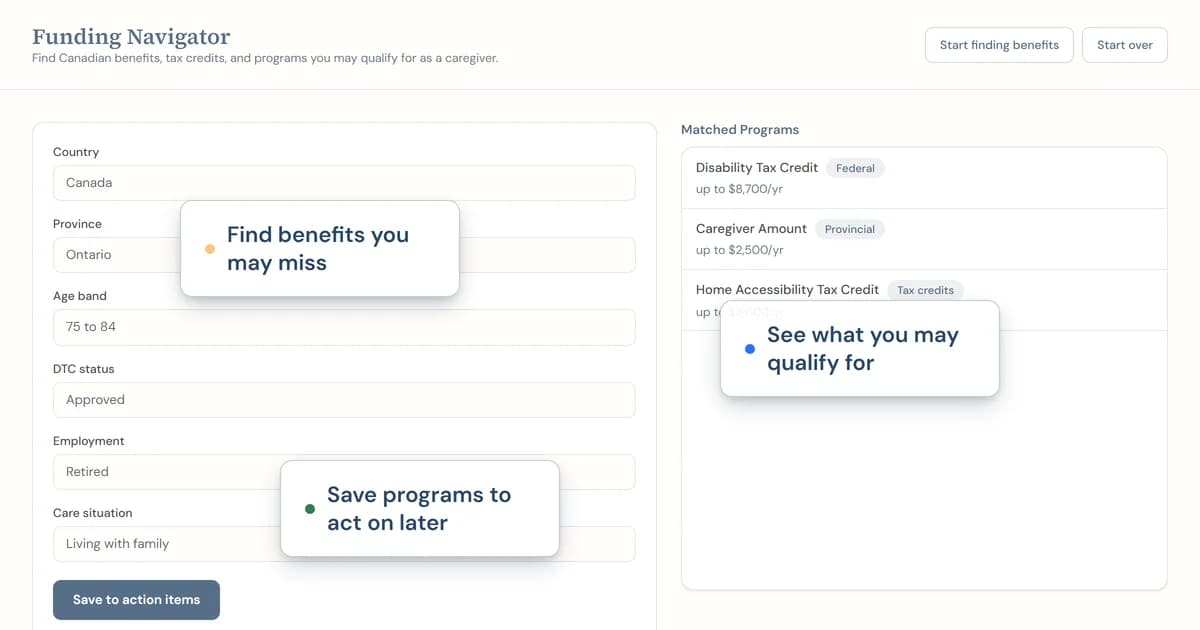
Funding Navigator gives that search a starting point. It is a page at /funding, where you answer questions about country, province, age band, Disability Tax Credit status, employment and care situation. The results group possible matches into gateway programs, tax credits, income support and provincial programs. Each result includes eligibility notes, an estimated amount and an official government link.
How does Funding Navigator help you find caregiver benefits?
Funding Navigator asks about the facts that change which programs may fit: where your parent lives, their age band, whether they have an approved Disability Tax Credit and whether you are employed or paying for care. It also asks about situations such as home renovations, private care or a parent moving into a suite. You do not have to know program names before you begin.
The page shows matched results with a "Why this matches" explanation. When a program needs an approved DTC first, the result can show the DTC gateway note. You can open the official government page for more detail, save a program to action items or start over. The navigator does not replace the government application or its current rules. It gives you a shorter list to check.
What you get
- A six-part question flow about country, province, age, DTC status, work and care situation
- Results grouped as gateway programs, tax credits, income support or provincial programs
- Eligibility notes and estimated amounts for each matched program
- A DTC gateway note when a program requires DTC approval first
- An official government link for each result
- A way to save a program to your action items
- A "Start over" option when your answers change
How it works
- Answer the questions about your parent and your care situation.
- Read the matched results, starting with the DTC gateway note when it appears.
- Open the official source or save the program to action items.
Which caregiver benefits should I check first?
Start with the Disability Tax Credit, or DTC. CareMapAI's verified July 2026 dataset puts it first because an approved DTC is required for the Canada Disability Benefit, can simplify Canada Caregiver Credit documentation and can enable attendant-care medical expense claims. The Canada Revenue Agency's DTC guidance explains the claim process.
Next, check the Canada Caregiver Credit. For the 2026 tax year, the verified dataset lists up to $8,773, with the amount reduced when the dependant's net income exceeds $20,601. The dataset says you do not have to live with your parent to claim it. Siblings can split the claim if their combined claims do not exceed the maximum. Read the Canada Revenue Agency's Canada Caregiver Credit guidance before filing.
The Canada Disability Benefit is an early rule-out for an aging-parent search. The verified dataset says it is for people aged 18 to 64 and requires an approved DTC. It does not apply to a parent aged 65 or over. That saves an afternoon on the wrong application.
Many families miss a credit and feel foolish after the tax year has passed. That is common. The verified dataset says the Canada Caregiver Credit can be claimed back up to 10 years through a T1-ADJ request, and Disability Tax Credit claims can also be retroactive. The CRA's return-change page explains how to request an adjustment.
What Ontario caregiver benefits should I look at?
For an Ontario parent aged 70 or older, check the Ontario Seniors Care at Home Tax Credit. The verified July 2026 dataset lists 25% of up to $6,000 in eligible expenses, for a maximum of $1,500 a year. It says the amount is reduced by 5% of family net income above $35,000 and fully phased out at about $65,000. The credit is claimed through Form ON479.
For a renovation, review the federal Home Accessibility Tax Credit and Multigenerational Home Renovation Tax Credit on their official pages.
Frequently asked questions
What should I check first for caregiver benefits in Canada?
Start with the Disability Tax Credit. CareMapAI's verified July 2026 dataset puts it first because an approved DTC is required for the Canada Disability Benefit, can simplify Canada Caregiver Credit documentation and can enable attendant-care medical expense claims. The Canada Revenue Agency's DTC page explains how to claim it.
How much is the Canada Caregiver Credit in 2026?
For the 2026 tax year, CareMapAI's verified July 2026 dataset lists the Canada Caregiver Credit at up to $8,773, with the amount reduced when the dependant's net income exceeds $20,601. The Canada Revenue Agency's Canada Caregiver Credit page explains the claim process.
Does the Canada Disability Benefit apply to a parent over 65?
No. CareMapAI's verified July 2026 dataset says the Canada Disability Benefit is for people aged 18 to 64 and requires an approved Disability Tax Credit. It does not apply to a parent aged 65 or over. See the Government of Canada CDB page.
What Ontario tax credit should I check for a parent aged 70 or older?
Check the Ontario Seniors Care at Home Tax Credit. CareMapAI's verified July 2026 dataset lists 25% of up to $6,000 in eligible expenses, to a maximum of $1,500 a year, for people aged 70 or older by December 31. See Ontario's program page.
Can I go back and claim caregiver credits from earlier years?
Possibly. CareMapAI's verified July 2026 dataset says the Canada Caregiver Credit can be claimed back up to 10 years through a T1-ADJ request, and Disability Tax Credit claims can also be retroactive. The CRA's change-a-return page explains the request.
Related reading
Read the Canada Caregiver Tax Credit, what senior care costs in Canada and how Canada's home-care and long-term-care system works. Browse all CareMapAI tools, including an emergency information sheet and tools for care-team coordination.
This is one of 31 free tools in CareMapAI.
Ready to use the Caregiver benefits Canada: where to start?
Register free to use itCareMapAI supports planning and organization. This service is not a substitute for professional medical advice, diagnosis, or treatment.