
Advance care planning in Canada
Advance care planning Canada starts with a conversation about your parent's values, preferences and the people who should know them. CareMapAI gives you a conversation guide, a treatment preferences summary and a review checklist so you can record what was discussed, revisit it and track document sharing.

The problem
Your parent says they do not want to talk about it today. You understand. Then a hospital visit, a fall or a hard family call makes the question feel closer. Everyone loves the same person, but nobody is sure who should speak, what has been said before or where the notes are.
The fear is not paperwork. It is having to guess. You do not want a rushed decision to turn into a family argument because the person at the centre of it never had room to say what mattered. A conversation now can be awkward. A conversation later may be impossible.
You are not the first
Many families put this off until there is a crisis, then wish they had started with one small question at the kitchen table. The first talk does not need to settle everything. It can begin with what makes a good day for your parent, who they trust and what they want their family to understand.
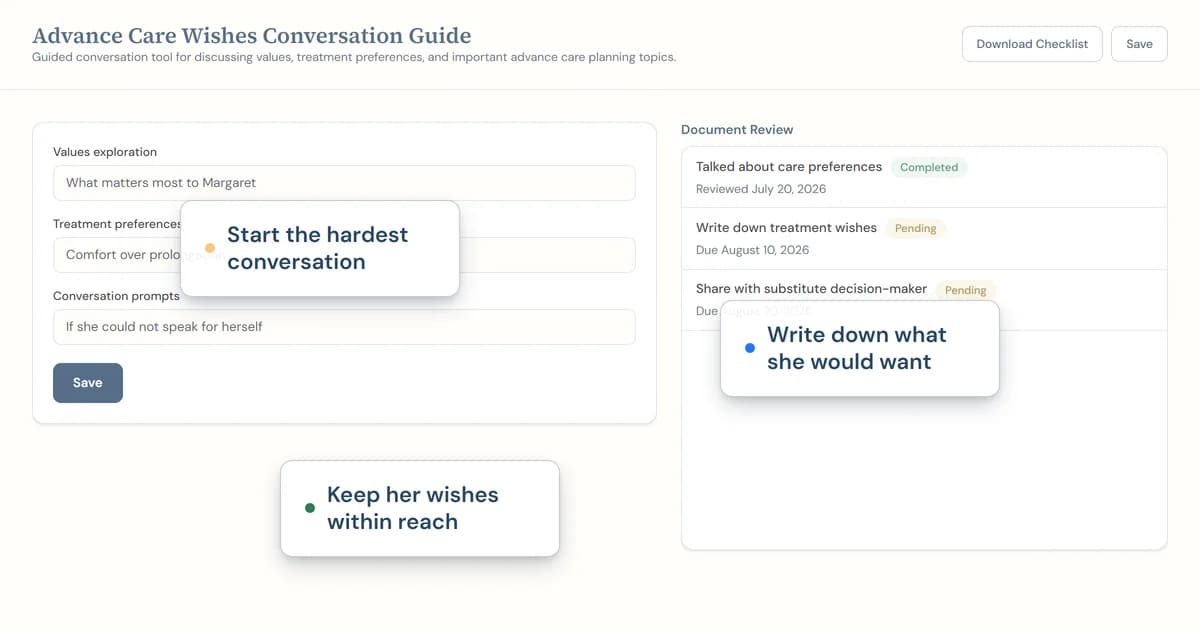
CareMapAI gives that talk a place to go. The Advance Care Wishes Conversation Guide records values, treatment preferences and conversation prompts. The Treatment Preferences Summary Builder keeps preference, conditions and notes for specific topics. The Advance Care Review and Sharing Checklist helps you review the record and track who has received it.
How does advance care planning Canada work in CareMapAI?
The Advance Care Wishes Conversation Guide lets you work through values exploration, treatment preferences and conversation prompts, then download a text-file summary. The Treatment Preferences Summary Builder covers CPR, ventilation, artificial nutrition, antibiotics, hospitalization and dialysis. It also has comfort priorities such as pain management, spiritual care, family presence, dying at home and music or environment.
The review checklist gives you four places to work: document review, decision-maker status, document sharing and document storage. Each item has a completed or pending checkbox, review date and notes. You can set an annual, semi-annual or quarterly review frequency, track who has received documents and download the checklist record. These tools organize your family's notes. They do not create a legal document or give legal advice.
What you get
- Conversation prompts for values exploration and treatment preferences
- A text-file conversation summary from the Advance Care Wishes Conversation Guide
- Treatment topics including CPR, ventilation, artificial nutrition, antibiotics, hospitalization and dialysis
- Preference, conditions and notes fields for each treatment topic
- Comfort priorities for pain management, spiritual care, family presence, dying at home and music or environment
- A review checklist for documents, decision-maker status, sharing and storage
- Review dates, notes, sharing records and a downloadable checklist
How it works
- Use the conversation guide to write down values, preferences and the points your parent wants discussed.
- Add treatment preferences and comfort priorities to the summary builder when your parent is ready.
- Review the documents and sharing record, then set the next review date.
What should advance care planning include?
Advance care planning Canada should begin with the things your parent wants people to understand about their life and care. Start with values. Ask what makes a day worth having, which people should be part of a conversation and what gives them comfort. The conversation guide has a place for those notes, so the answer does not disappear after one difficult talk.
Treatment preferences may come next. The summary builder has topics for CPR, ventilation, artificial nutrition, antibiotics, hospitalization and dialysis, plus fields for preferences, conditions and notes. You do not need to force every topic into one sitting. A clear note that says not discussed yet is more honest than a choice made under pressure.
Keep the document work separate from the conversation. The review checklist can track whether the document has been reviewed, where it is stored and who has received it. That makes the next step visible without pretending that the checklist itself settles the legal question.
Where can I find official advance care planning rules in Canada?
Advance care planning rules differ by province and territory. CareMapAI does not give legal advice, so use the tools to organize your conversation and then check the official source where your parent lives. For Ontario, see the province's power of attorney guidance. British Columbia publishes substitute decision-making and incapacity planning guidance. Quebec publishes advance medical directives guidance.
These links are starting points, not a substitute for province-specific legal advice. Read the current official material before completing, changing or relying on a power of attorney, representation agreement or directive. If your family's situation is complex, ask a qualified professional in the province where your parent lives.
Frequently asked questions
What is advance care planning in Canada?
Advance care planning is a way to discuss and record your parent's values, treatment preferences and the people who should know them. CareMapAI's tools organize those conversations and notes. They are not legal advice or legal documents. Rules about powers of attorney, representation agreements and directives differ by province and territory.
Do I need a lawyer for advance care planning?
It depends on the document and your province or territory. CareMapAI can help organize the conversation, preferences, review dates and sharing record, but it does not give legal advice. Check your provincial source before preparing a power of attorney or directive. Ontario, British Columbia and Quebec each publish their own official guidance.
What should I ask my parent about future care wishes?
Start with values, treatment preferences and the people your parent wants involved in decisions. The Advance Care Wishes Conversation Guide has sections for values exploration, treatment preferences and conversation prompts. Write notes in plain language, then return to the topic later if your parent wants more time to think.
Can I keep track of who has received advance care documents?
Yes. The Advance Care Review and Sharing Checklist tracks document reviews, decision-maker status, document sharing and document storage. Each item has a completed or pending checkbox, review date and notes. The sharing section records who documents have been shared with, so you can see what still needs follow-up.
Can I download my advance care planning notes?
Yes. The Advance Care Wishes Conversation Guide, Treatment Preferences Summary Builder and Advance Care Review and Sharing Checklist each create a text-file download. The files hold the conversation summary, treatment preferences or checklist record you created. Keep downloaded copies private and check the current document before you share it.
Related reading
Read wills and powers of attorney and things to know about hospice care. Browse all CareMapAI tools, including an emergency information sheet and a memory change tracker.
This is one of 31 free tools in CareMapAI.
Ready to use the Advance care planning in Canada?
Register free to use itCareMapAI supports planning and organization. This service is not a substitute for professional medical advice, diagnosis, or treatment.