
How to track memory changes in a parent
To track memory changes in a parent, write down the date, the type of concern and a plain description of what happened. CareMapAI's Memory Change Tracker stores those observations, lets you download the history and helps you bring a clearer record to a doctor or clinic visit.

The problem
At the doctor's office, someone asks for an example of what has changed. You know there have been moments. A question was asked twice. A plan was forgotten. A familiar word did not come. But the details have been scattered across weeks, and now the clearest thing you can say is that something feels different.
You are caught between two fears. You do not want to brush off something that matters. You also do not want one tired afternoon to become a story bigger than it is. What you need is a record of what you actually saw, without having to turn yourself into a clinician.
You are not the first
Most caregivers start with a note in their phone or a sentence in a text message to a sibling. The notes are often honest but hard to use later: one says more forgetful, another says seemed confused, neither has a date or an example. By the next appointment, the pattern is still in your head but the details are gone.
The Memory Change Tracker gives each observation a date, a type of concern and a description. You keep the examples in your own words. The tool stores the record, creates and updates its note summary and connects to the reminder system. It gives you a history to read before you speak with a doctor.
How does the Memory Change Tracker work?
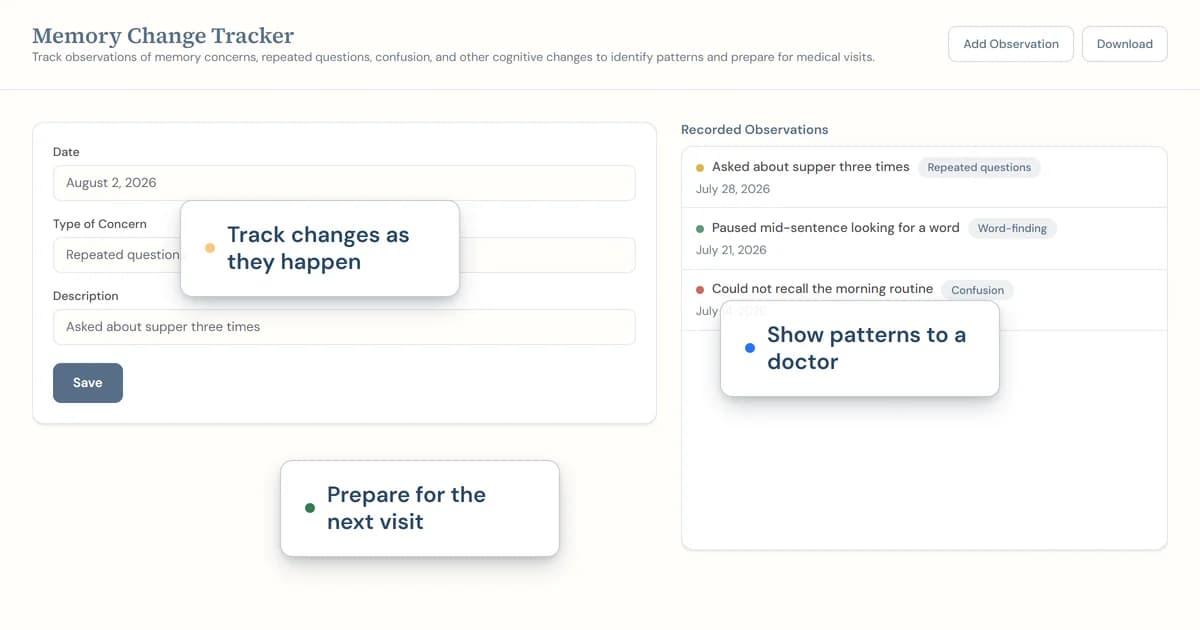
The Memory Change Tracker has an Add Observation form with Date, Type of Concern and Description fields. You can save an observation when something happens, then return later to add the next dated entry. The tool records observations of memory concerns, repeated questions, confusion and other cognitive changes.
Its Download button creates memory-observations-YYYY-MM-DD.txt with all entries. The tracker also has note-summary and reminder-system integration. It is a place to keep a record for a medical visit. It does not detect, screen for or assess dementia risk, and it does not decide what an observation means.
What you get
- A dated observation record for memory concerns and other cognitive changes
- A Type of Concern field for each observation
- A Description field for the example you want to keep
- Add Observation, Save and Download controls
- A text file named
memory-observations-YYYY-MM-DD.txtwith all entries - Note-summary integration for the record you create
- Reminder-system integration
How it works
- Add an observation with the date, concern type and a plain description.
- Save the next example when it happens instead of relying on memory later.
- Download the history before a doctor or clinic visit.
How should I track memory changes in a parent?
To track memory changes in a parent, write down what happened in words a doctor can picture. Put the date first. Then choose the type of concern and describe the moment itself. A record that says Tuesday, repeated the same question after lunch is clearer than a note that says getting worse.
Keep one observation to one moment. If your parent forgot an appointment, write the date and what was said or done. If they asked a question again, write the question or the setting. Do not guess at a cause. The tracker is for the facts you noticed, not an explanation of why they happened.
Take the downloaded record to a doctor or clinic visit when you want to discuss the changes. The record can help you remember dates and examples under pressure. It does not turn your notes into a diagnosis. Your job is to keep the examples. The doctor's job is different.
What can I bring to a doctor about memory changes?
Bring the dated observations, a current medication list and the questions you want to ask. The Memory Change Tracker download gives you all recorded entries in one text file. The Medication & Appointment Organizer can keep the medication name, dosage, schedule, refill date and notes in a separate list.
Before the appointment, read the earliest and latest observation. That can help you describe whether the examples are recent, repeated or changing over time. Keep the language simple. You do not need to use medical terms to give a doctor a useful account of what you saw.
Frequently asked questions
What should I write down when I notice memory changes in my parent?
Write the date, the type of concern and a plain description of what happened. The Memory Change Tracker has fields for Date, Type of Concern and Description. Use examples you saw or heard, rather than trying to explain what caused them. A short dated record is easier to discuss at a doctor visit.
Can a memory tracker diagnose dementia?
No. The Memory Change Tracker records your observations. It does not detect, screen for or assess dementia risk. Use the record to keep examples together and take it to a doctor or clinic visit if you want to discuss changes you have noticed. A record can support the conversation without making a diagnosis.
Can I download the memory observations I record?
Yes. The Memory Change Tracker has a Download button that creates a text file named memory-observations-YYYY-MM-DD.txt with all entries. Downloading the history gives you a copy to review before a visit or share with someone your parent has asked to help with the record.
What types of concern can I track?
The Memory Change Tracker records observations of memory concerns, repeated questions, confusion and other cognitive changes. Add the type of concern that best describes what you noticed, then write the description in your own words. The tool stores the observation as a record. It does not decide what the observation means.
Should I wait until I have many observations before talking to a doctor?
You do not need a large record before raising a concern with a doctor. A dated example can help you describe what you noticed and when. Keep adding observations if changes continue, but do not treat the tracker as a reason to delay a conversation you feel needs to happen.
Related reading
Read understanding memory changes in aging, conditions that can be mistaken for dementia and the stages of Lewy body dementia. Browse all CareMapAI tools, including a medication and appointment tracker and advance care planning tools.
This is one of 31 free tools in CareMapAI.
Ready to use the How to track memory changes in a parent?
Register free to use itCareMapAI supports planning and organization. This service is not a substitute for professional medical advice, diagnosis, or treatment.