
Caregiver burnout signs: a weekly check-in
Caregiver burnout signs can show up as a week when your energy, mood, stress, sleep or sense of overwhelm has changed. CareMapAI's Burnout & Wellbeing Check-In lets you rate seven parts of your wellbeing from 1 to 5, add a note and review recent averages alongside your history.

The problem
You answer one more late-night text, move one more appointment and tell yourself you will catch up after this week. Then the next week looks the same. You can feel that something has changed in you, but there is no pause long enough to name it. The care work keeps taking the space that would have shown you how much it costs.
The fear can be hard to say aloud. You may worry that admitting you are stretched too thin means you are letting your parent down. It does not. Burnout is a workload problem, not a character problem. You deserve a record that notices your week without turning it into a verdict.
You are not the first
Many caregivers can tell you the exact day a task became too much, but not how long the pressure had been building before then. The warning signs are easy to explain away when a parent needs help today. Sleep can wait. A missed meal can wait. A quiet hour can wait. That is how a full week disappears.
The Burnout & Wellbeing Check-In makes a small place for your side of the work. It asks for a fast rating, not an essay. You choose the numbers and the optional note. Over time, the history gives you something more solid than a vague feeling when you need to look at what has changed.
How does the Burnout & Wellbeing Check-In work?
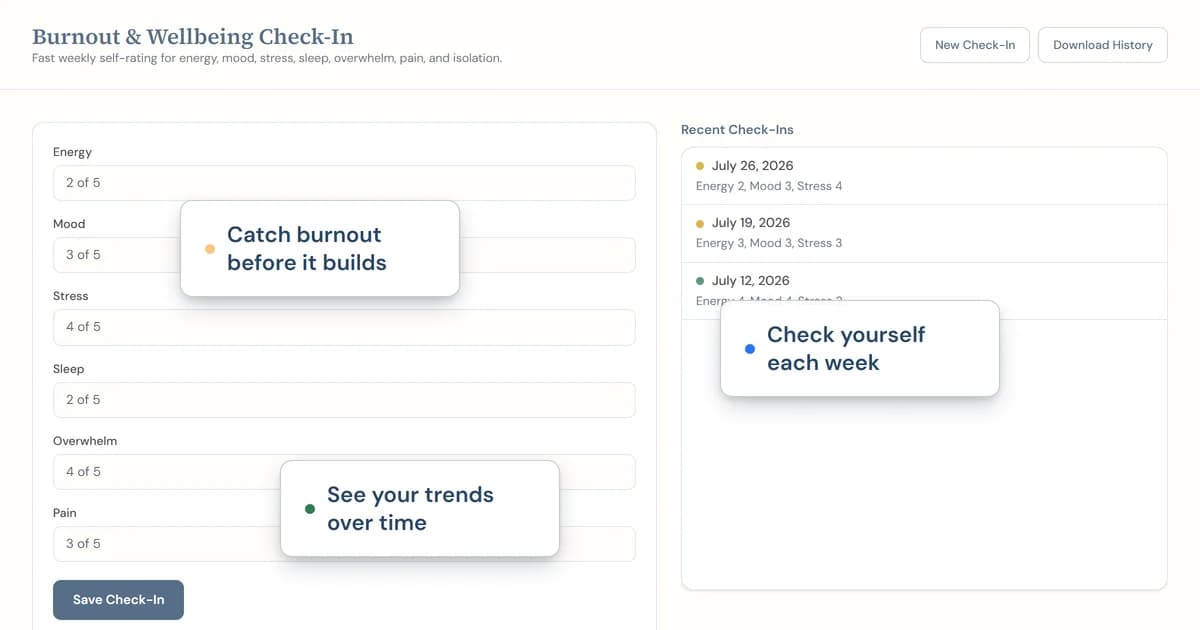
The Burnout & Wellbeing Check-In uses 1 to 5 sliders for energy, mood, stress, sleep, overwhelm, pain and isolation. You can add an optional note for the week, then save the check-in. The tool shows recent averages from your last 5 check-ins and keeps a full history of what you recorded.
You can start a new entry with New Check-In and save it with Save Check-In. Download History creates a text file of the record. The tool has no direct cross-tool data. It is a weekly self-rating check-in, not a clinical screening tool and not a diagnosis.
What you get
- Seven 1 to 5 sliders for energy, mood, stress, sleep, overwhelm, pain and isolation
- An optional notes field for the week behind the ratings
- A New Check-In control and Save Check-In button
- Recent averages based on the last 5 check-ins
- A full history of the check-ins you saved
- A text-file download from Download History
How it works
- Rate the seven areas from 1 to 5 and add a note if you want one.
- Save the weekly check-in, then return on the same day next week.
- Read the recent averages and history, or download the record when it helps.
What caregiver burnout signs can I track week to week?
Caregiver burnout signs can be hard to notice because they often arrive as ordinary changes in a crowded week. The check-in gives you seven places to look: energy, mood, stress, sleep, overwhelm, pain and isolation. Rate each one from 1 to 5. The number is not a diagnosis. It is a way to make the week visible.
Add a note when a number needs context. You might write that your parent had three appointments, that a sibling covered a visit or that sleep was broken after an overnight call. A note gives the history a fact to sit beside the rating. It can show why one week felt different from the next.
Use the recent averages as a prompt to read your own record. If a pattern concerns you, bring it into a conversation with someone you trust or a professional support you already use. The tool does not tell you what to do. It gives you words and dates for a conversation that can otherwise be easy to postpone.
How can I talk about needing more support?
Begin with one concrete week. Instead of saying everything is too much, name the appointments, overnight calls or tasks that made the week hard to carry. The optional note in a check-in can give you that starting point. Then say what would change the next week: a ride, a meal, a covered visit or time away from the phone.
Caregivers often wait until they can explain the whole problem perfectly. You do not need to. A recent average, a note and one clear request are enough to start. The full history is there if you want to see a longer pattern before the conversation.
Frequently asked questions
What are common caregiver burnout signs to keep track of?
You can keep track of changes in energy, mood, stress, sleep, overwhelm, pain and isolation. CareMapAI's Burnout & Wellbeing Check-In uses a 1 to 5 slider for each of those areas and gives you space for an optional note. It is a weekly self-rating record, not a clinical screening or diagnosis.
Can a caregiver burnout check-in diagnose burnout?
No. The Burnout & Wellbeing Check-In is a weekly self-rating tool. It records how you rate energy, mood, stress, sleep, overwhelm, pain and isolation. It does not diagnose burnout or replace professional support. Use the history to notice your own pattern and decide what conversation or support you may need.
How often should I use a caregiver wellbeing check-in?
Use it weekly if that rhythm works for you. The Burnout & Wellbeing Check-In is designed as a fast weekly self-rating and shows recent averages from the last 5 check-ins alongside the full history. A regular day, such as Sunday evening, can make the record easier to keep without adding another daily task.
Can I add a note to my caregiver check-in?
Yes. Each Burnout & Wellbeing Check-In has an optional notes field. Use it for the fact behind a number, such as a week with extra appointments, a night of broken sleep or a sibling who covered a visit. The note can make the history easier for you to understand later.
Can I download my caregiver wellbeing history?
Yes. The Burnout & Wellbeing Check-In has a Download History button that creates a text-file history of your check-ins. You can keep the file as a private record or review it before a conversation about the support you need. It contains your self-ratings and the notes you chose to add.
Related reading
Read caregiver burnout: nobody prepared me for this, ways to practice self-care for caregivers and how to get enough sleep as a caregiver. Browse all CareMapAI tools, including care-team coordination and caregiver benefits in Canada.
This is one of 31 free tools in CareMapAI.
Ready to use the Caregiver burnout signs: a weekly check-in?
Register free to use itCareMapAI supports planning and organization. This service is not a substitute for professional medical advice, diagnosis, or treatment.